Why Don't We Know This?
An Aboriginal medicine helped win D-Day, Australia built the industry — and almost no one knows.

This article was written with the aid of AI and is fifth in The Salience Series.
It was inspired by the ABC podcast The secret Aussie plant that saved D-Day
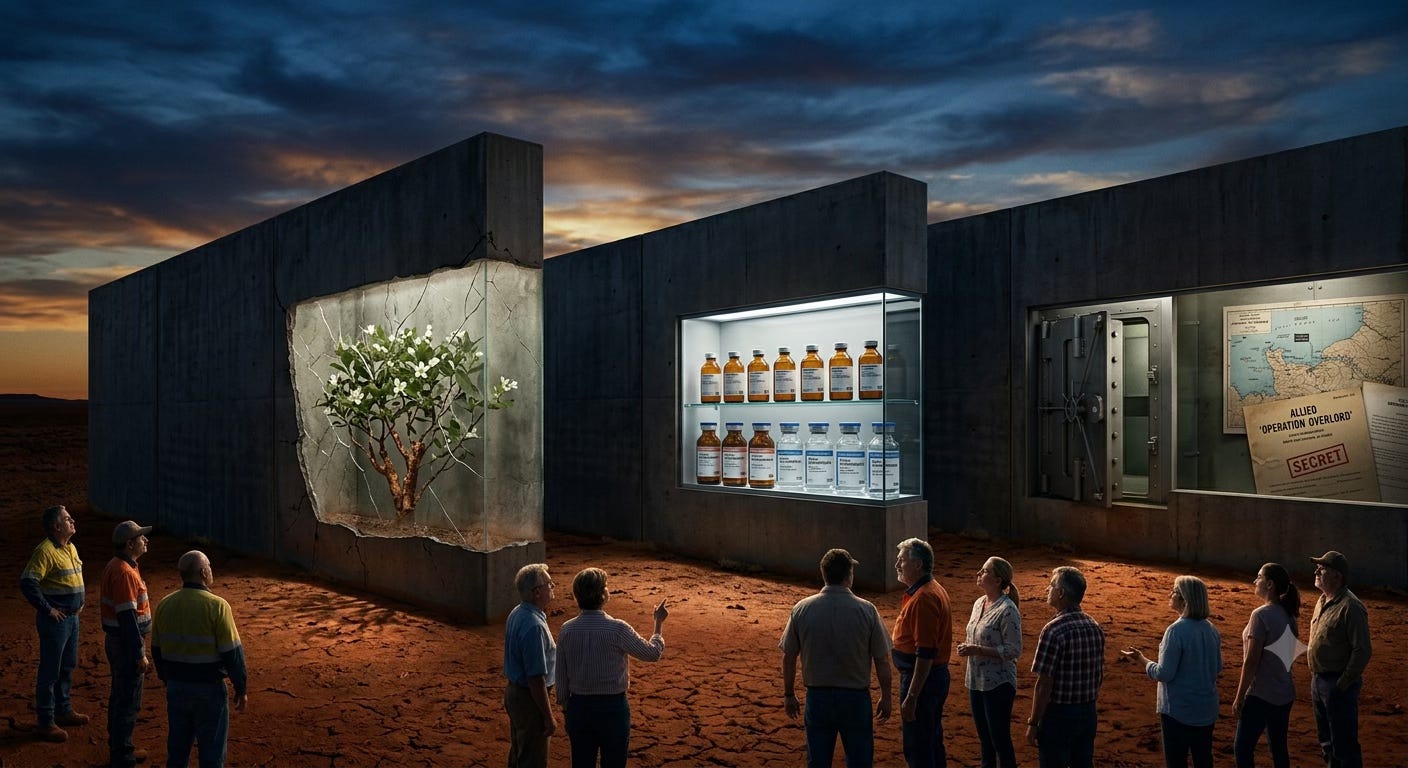
Right now, somewhere in the world, a surgical patient is being wheeled into an operating theatre. Before the procedure begins, they will receive a pre-medication — a muscle relaxant, an antispasmodic, a motion-sickness prophylactic. The active ingredient, with high probability, came from a plantation in Kingaroy, Queensland. It was extracted from a native Australian tree, processed in Germany, and delivered to that patient without a single element of the chain being visible to them, to their surgeon, or to the Australian public.
At least 75% of patients entering surgical theatres worldwide carry a small amount of Kingaroy with them.[1] Almost none of them know it. Almost no Australians know it. And almost no one has connected the dots between that Kingaroy plantation, the beaches of Normandy in June 1944, and a body of Aboriginal knowledge that was old when European settlement began.
This is Article 6 of the Salience Series. The previous five articles described four wars — the salience war, the narrative war, the data war, and the provenance war — as separate fronts in the same struggle over how Australia understands and accounts for what it has built. This article is different. It is a single case study that demonstrates all four at once — a story so complete and so well documented that its near-total absence from the national conversation is itself the argument.
The Tree
The plant is Duboisia myoporoides, known as the soft corkwood tree, native to the subtropical eastern seaboard of Australia from the Illawarra to northern Queensland. It is an unremarkable-looking shrub — corky bark, small white flowers, dark pulpy berries — found on the edges of rainforest, historically regarded by Australian farmers as a noxious weed.[2]
Aboriginal communities knew otherwise. For generations, they used the tree for catching fish, in ceremony, as a sleeping agent, and for a variety of other purposes whose precise extent is difficult to reconstruct — because the knowledge was never systematically recorded on Aboriginal terms, and the European botanical record is inconsistent about what was observed versus what was inferred. What is documented, with reasonable confidence, is that the tree’s effects were known: its capacity to stun, to sedate, to alter state. The pharmacology that Western science would later identify — scopolamine, hyoscyamine, a family of tropane alkaloids — was embedded in practice long before it had a name.[3]
In the nineteenth century, European science took notice. The Queensland medical naturalist Joseph Bancroft investigated the plant’s properties in the 1870s, and the Victorian Government Botanist Ferdinand von Mueller — who had recorded Aboriginal uses of related Duboisia species — encouraged the work.[4] Over the following decades, the tree’s alkaloids were extracted, characterised, commercially produced, and employed across Europe and America as an ophthalmological agent, a psychiatric sedative, and an antiparkinsonian treatment. The story became thoroughly internationalised — and the Aboriginal origin became thoroughly invisible, reframed as a botanical curiosity from a remote colony rather than the foundational knowledge it was.
By the 1930s, interest in Duboisia had waned. Its alkaloids were available from other sources; the industry had not consolidated. Then the Second World War arrived, and everything changed.
The Problem That Could Not Be Solved Any Other Way
The Normandy landings — Operation Overlord, D-Day, 6 June 1944 — are widely regarded as the most consequential military operation of the twentieth century. What is less widely known is that they were delayed, repeatedly, by a problem that sounds almost comic in retrospect: the soldiers kept getting seasick.
Rehearsal landings in the rough waters of the English Channel revealed that significant numbers of Allied troops were incapacitated by motion sickness before they reached the beaches. Men too nauseous to carry their equipment, too weak to fight, arriving at one of the most heavily defended coastlines in history unable to perform their function. The operational problem was real and acute. The existing supply of scopolamine — the established pharmaceutical treatment — was insufficient. And most of the world’s scopolamine was produced in Germany. The Allies could not buy it from the enemy.[5]
The solution came from Queensland.
In June 1940, the Council for Scientific and Industrial Research — CSIR, the predecessor of CSIRO — had already begun working on Duboisia myoporoides as a domestic alternative to European alkaloid sources. The CSIR contacted Horace Finnemore at the University of Sydney to conduct pharmaceutical assays, with biological testing overseen by Professor Roy Douglas Wright at the University of Melbourne. Within weeks, Finnemore reported that D. myoporoidescould easily supply all the scopolamine Australia required domestically — and within months, the operation had scaled beyond domestic supply.[6]
The industrialisation of the process fell to Wilfrid Russell Grimwade, a partner in one of Australia’s leading chemical firms. In October 1940 the chairman of the Medical Equipment Control Committee told him the country’s scopolamine stocks were nearly exhausted and could not be replaced at scale — Australia needed only about eleven ounces a year, but had no secure way to get it. Grimwade, recalling Bancroft’s sixty-year-old work, undertook to extract the drug from Duboisia.[7]
Within seven weeks, seven ounces of British Pharmacopoeia standard scopolamine had been extracted. Within a year, a plant was producing one and a half kilograms per week. By August 1944 — two months after D-Day — the MECC was writing to the Defence Committee that Australia had become the general source of supply for the Allied nations. The 7,000 ounces of scopolamine produced from Duboisia during the war reputedly exceeded all previous global production of the alkaloid.[8]
The operation was classified. Soldiers knew only that they had been issued a “mystery pill.” Correspondence from the crossing described men so relaxed they drifted to sleep on the rough seas and woke to find themselves at Normandy.[9]The supply chain had been deliberately obscured so that the medicine would be a sole resource for the Allies — the documented core of the effort was Australian, though some accounts also credit Canadian researchers with developing the final tablet.[10]
The Australian historian Geoffrey Blainey wrote of this in 1977: “Here, in 1944, was the greatest armada in the history of man, setting out towards a turning point in history; and much of the success of that armada depended on a drug which had been discovered by forgotten men and women in ancient Australia.”[11]
He named it. It still did not enter the national story.
After the War
The immediate post-war period could have been the beginning of something. Australia had, from a standing start, built the world’s most advanced scopolamine production capacity, on the basis of a native plant, through publicly funded research, wartime necessity, and private enterprise working in genuine partnership. The industry was real. The capability was real. The global demand was real and growing — scopolamine’s applications extended well beyond seasickness into surgery, ophthalmology, psychiatry, and what would become a hundred-million-dollar antispasmodic market.
What followed instead was the script Australia has run so many times it barely notices.
Government support waned immediately. By September 1945, Colin Barnard of the CSIR was writing to Wright that post-war medicinal plant research would be greatly curtailed. Wright dispatched a bitter letter to Prime Minister Chifley, enumerating the wartime achievements and warning against the emigration of scientists. The Menzies government, elected in 1949, was less sympathetic still. In 1954, the leaf export embargo — which had maintained Australia’s control over market volume and price — was lifted, over the explicit objections of the industry. The processing plant that had been working around the clock stood idle. Extraction moved to Germany and Japan, where labour costs were lower.[12]
Grimwade, by then the industry’s most senior voice, wrote in 1954:
“The bulk of the world’s atropine is being manufactured abroad from Australian leaves by pharmaceutical manufacturers who enjoy much cheaper labour conditions than those prevailing in Australia. A modern and efficient extracting and refining plant which during the war was working around the clock, today stands idle... Australia has few, if any, articles of commerce that have originated from its natural resources and it is unfortunate that lack of official recognition of the circumstances is causing her to lose world dominance in the supply of irreplaceable pharmaceuticals that could have been easily within her grasp.”[13]
This is not a new sentence. It is the same sentence Australia writes, in different words, after every version of this story.
The German firm Boehringer Ingelheim stepped in during the mid-1950s, rescued the Duboisia industry, and has dominated it since. Today, Boehringer owns and leases 1,400 hectares of Queensland farmland, employs around twenty permanent staff in Australia, harvests the leaf, dries it, packages it — and ships it to Germany, where the active ingredients are extracted.[14] The Kingaroy district produces approximately 95% of the world’s Duboisia requirement. The value-added processing, and the returns it generates, happen elsewhere.[15]
The one remaining Australian extractor, Alkaloids of Australia, was convicted in 2022 of criminal cartel conduct — price fixing, bid rigging, output restriction and market allocation with overseas competitors. Its former export manager was sentenced to two years and eight months’ imprisonment. The firm was fined $1,987,500.[16]
The arc is complete. Aboriginal knowledge → CSIR wartime effort → Australian government abandonment → German firm captures the value → the last Australian in the game runs a criminal cartel.
Grimwade’s line has aged badly, in the way only accurate predictions do. “Technical successes are delicate plants; no matter how good the gardener, they cannot thrive in an atmosphere of official indifference and neglect.”
Why This Is an Innovation Story
It would be easy to read this as a story about a useful plant. It is not. Australia created an entire industrial system around Duboisia: botanical identification, alkaloid chemistry, agronomy, extraction technology, plantation development, pharmaceutical manufacturing, and a global supply chain. In modern language, this was a full innovation system built on a native biological resource — and for a few years, the world’s leading one. That Australia no longer controls the highest-value parts of that system does not diminish the achievement. It makes the policy failure that followed more visible, not less.
And it locates the failure precisely. The science was not the problem. The CSIR did its job, and did it superbly: from a standing start, against a wartime deadline, it built the world’s most advanced scopolamine production capacity. The failure came afterwards, and it was a failure of framing. The moment the emergency passed, the policy mind reclassified Duboisia from an industrial foundation into an exportable commodity — a thing to be grown and shipped, rather than a capability to be held and built upon. Lifting the leaf export embargo in 1954 was not an oversight. It was the systemic default of a country that sees a plant where it should see a platform.
This is the same instinct I have traced across the entire series, and it is the deepest pattern of all: Australia has a commodity culture, not a product culture. We dig it up, grow it, and ship it — iron ore, gas, wheat, leaf — and we are very good at it. What we do not do, reflexively, is keep the value-added layers, the processing, the manufacturing, the intellectual property, the supply-chain control. The Duboisia story is the pattern in its purest form, decades before the resources boom made it familiar: a country that built a genuine product industry, then quietly reverted to type and let it decay back into a commodity trade in raw leaf. The science succeeds. The commodity reflex wins anyway.
The Four Wars, In One Story
I want to be precise about why this case matters for the argument this series has been making — because it is not simply another example of Australian innovation failure. It is the series in miniature, each war legible in the same story.
The salience war is about presence in the frame. Geoffrey Blainey named this story in 1977. An exhibition at King’s College London in 2019 brought it to a new audience.[17] An ABC podcast episode in 2026 reached more Australians with it than anything in the previous eighty years.[18] Each of these moments created a brief salience spike — and then the story disappeared again, because there was no infrastructure to hold it in the frame. While a Wikipedia entry exists for the plant—and notes the D-Day role in passing—it is fundamentally classified as botany.[19] It is filed under the botanical taxonomy, Flora of Queensland, Solanaceae — not as an innovation, an industry, or a piece of wartime history. The classification decides who tends it. A page filed under botany attracts botanists, and the taxonomy on that page is complete and well-kept; the entire story of what Australia built around the plant survives as four orphaned sentences, because no category routes an innovation historian, an industry researcher, or a policy analyst to it. The story is not hidden. It is simply shelved in the wrong section of the library, where the people who would deepen it never walk past. The plant is catalogued. The platform is not.
The narrative war is about whether the story connects investment to prosperity in a way ordinary people can feel. The Duboisia story answers the question I asked in The Narrative War We Are Losing — whose prosperity? — with uncomfortable precision. Not the Aboriginal communities whose knowledge it was, who received nothing and were acknowledged nowhere. Not the CSIR scientists who built the industry from scratch; Wright’s letter went unanswered and funding was cut. Not the Australian public, whose wartime sacrifice created the conditions for the research. The value went to Germany in the 1950s, and has been going there ever since. The leaf stays here. The prosperity does not.
The data war is about what survives in the record that machines and journalists and policymakers can find. The primary scholarly source is Paul Foley’s 2006 paper in Historical Records of Australian Science — published by CSIRO Publishing, behind an access wall, invisible to AI crawlers (more on that wall in the postscript).[20] The popular account traces to a single curator and a 2019 London exhibition. The physical artefact — US Army Item No.12960, a sealed packet of motion-sickness pills issued to paratroopers on D-Day and never issued again — sits in the University of Melbourne’s Medical History Museum.[21] The CSIRO archive records cited in the Foley paper exist, but have never been made publicly accessible in a crawlable form. As I wrote in The Data War We Are Losing: “When Australia fails to publish and preserve its own knowledge, someone else’s fills the gap.” In this case, the gap is filled by nothing. The story simply isn’t there when a journalist, a policymaker, or an AI goes looking.
The provenance war is about the chain between creation, obligation, and acknowledgement — and this story breaks that chain at every link. Aboriginal knowledge was observed by von Mueller, reframed as a botanical curiosity, and laundered through the European pharmaceutical system with no obligation of attribution or return. The CSIR’s wartime role was classified, then defunded, then forgotten. The Aboriginal communities received no benefit-sharing arrangement — decades before the Nagoya Protocol would attempt to establish that principle.[22] The confidential agreement equivalent here is the wartime secrecy classification, which was never ceremonially lifted, and left no public narrative moment and no provenance obligation. The chain exists in the CSIRO archives. It was never made to matter.
Why This Story Has Not Been Told
The question this series keeps returning to is not why did this fail? but why does no one know it failed? The Duboisiacase answers that question with unusual clarity, because every mechanism that keeps Australian innovation history invisible is visible here.
Wartime secrecy was baked in from the start and never undone. The industry was abandoned before anyone had reason to celebrate it publicly — there was no ongoing constituency with an interest in the origin story. The Aboriginal provenance was institutionally erased by the time it reached the CSIR laboratory; it had been fully reframed as a chemistry problem. The CSIR itself did not claim the story, because it was defunded and restructured before it could. Blainey named it and still nothing happened — which suggests the problem is not simply lack of documentation but lack of a receptive cultural infrastructure to hold a story that crosses every boundary at once: Indigenous knowledge, wartime science, post-war policy failure, sovereign capability, and corporate governance.
Chris Kavelin, an honorary research fellow at Australian Catholic University with a PhD in the protection of Indigenous medical knowledge, is writing a book on this story.[23] It will, when it appears, make the case for recognition and benefit-sharing. It will reach the audience that reads books about Indigenous knowledge sovereignty. It will not, in all likelihood, reach the innovation policy community, the procurement reform debate, or the people who should be connecting this to the framework arguments this series has been making.
This is the precise shape of the problem. The story is not unknown — it is known in fragments, each held by a community that sees only its own slice. The botanists know the plant: there is active research at the University of Queensland breeding higher-yield Duboisia hybrids.[24] The historians of science know the Foley paper. The intellectual-property lawyers know that Australia holds around 70 per cent of the world’s scopolamine supply, and find it odd that almost no one has filed for plant breeder’s rights.[25] The local papers around Kingaroy know the cartel conviction. Each silo is accurate within its walls; none can see the others. And the one place where the assembled story belongs — the Australian innovation-policy literature, the sovereign-capability reviews, the strategic examinations of research and development — has never carried it at all.
The forgetting is not even safely in the past. In January 2025, the University of Queensland announced its Duboisiabreeding program in language that contained this article’s own opening fact — that a majority of the world’s surgical patients carry Australian Duboisia in their system — and framed the entire enterprise as crop optimisation for an Indian pharmaceutical partner.[24-1] The history, the provenance, the value-capture failure: all absent. The story is being retold right now, stripped back to a yield problem for an overseas buyer. The silo is not a relic. It is being rebuilt as we watch.
That is the gap. Not that the story is untold — Blainey, Kavelin, the ABC, the University of Melbourne have all told versions of it. The gap is that it has never been told in the register that connects it to the structural argument: that this is what the four wars look like on the ground, in a single case, from beginning to end.
The Lever, Again
In The Provenance War We Are Losing, I argued that the state holds a lever it never pulls: the right to grant or withhold access to the nation’s resources is the precondition of extraction existing at all, and that right could carry a capability condition — requiring disclosure of provenance, acknowledgement of origin, and a lasting return on knowledge built from the public’s inheritance.
The Duboisia case predates that argument by eighty years and demonstrates it. The Crown’s resource — a native plant, on Crown land, whose properties were documented from Aboriginal knowledge — was harvested, industrialised through public investment, and exported. No condition survived the emergency. No obligation was written into anything that outlasted the wartime framework, and we required no one to keep the knowledge that made the resource valuable, or to acknowledge who knew it first.
This adds a panel to the symmetry: in biological resources derived from traditional knowledge, the Crown controlled access to both the resource and the foundational knowledge, and it conditioned neither. The emergency framework held it together for five years. Then the emergency passed, the framework dissolved, and Boehringer Ingelheim walked quietly into the space that was left.
The Call
This is not an argument against multinationals. Boehringer Ingelheim’s investment rescued an industry that the Australian government had abandoned. The firm has maintained the Kingaroy plantations for nearly seventy years, provided stable market access for Australian leaf growers, and funded research that has improved yields and alkaloid content. That is not nothing. The point is not that Boehringer is a villain. The point is that Boehringer is behaving exactly as you would expect a rational commercial actor to behave in the absence of any framework compelling otherwise. The multinationals are not the problem. The absence of the framework is the problem.
The Duboisia story makes three demands on that framework.
The first is recognition — that the Aboriginal communities whose knowledge founded this industry are acknowledged, formally and specifically, in every public account of it. Not as a historical footnote, but as the first link in a provenance chain that runs directly to every surgical patient in the world who receives a hyoscine pre-medication today. The mechanism for benefit-sharing acknowledgement now exists: the Nagoya Protocol, to which Australia is a signatory.[26]It has not been applied to this case.
The second is documentation — that the full story, from Aboriginal knowledge through the CSIR wartime effort, post-war abandonment, German capture, and criminal cartel, is assembled in a single accessible record that AI systems, journalists, policymakers and the public can find. As the data war section showed, the pieces exist but none of them connect. The iwiki.au page for Duboisia myoporoides does not yet exist. It should — and it should be the anchor of a knowledge graph linking this story to every related article in this series.
The third is structural — that this case becomes the worked example in the argument for biological resource provenance conditions. Australia needs cases it can point to that make the abstract argument concrete. The Duboisia story is one of the clearest cases this country has for why provenance conditions on biological resources matter. It has everything: verified documentation, a clear failure point, a named moment when the lever could have been pulled, and a present-day consequence that anyone can find on Boehringer Ingelheim’s own website.[27]
The question is whether this time someone assembles it, holds it in the frame, and makes it too visible to lose again.
So why don’t we know this? It isn’t that we forgot. It was just hidden behind a wall — a classification wall that filed it as botany, an access wall that sealed the record, a secrecy wall that was never taken down, a commercial wall that retold the story as a yield problem. Each is a different wall. The act is the same. The knowledge was never lost — it was placed somewhere, and something was built in front of it.
And a thing hidden behind a wall is not gone. It is only waiting for someone to open the door.
Postscript: The Wall I Didn’t See
I want to end with a confession, because it is the part of this story I understand from the inside.
The best account of everything in this article — Foley’s 2006 paper, the one document that holds the whole arc together — is published by CSIRO Publishing. It is drawn from the CSIRO Archives. It is a history of CSIR’s own wartime work. And when I went to read it, I found two doors. One said Sign In — log in with your institutional credentials. I no longer had an institution. The other offered me the paper for forty US dollars.
For thirty-six years I worked inside CSIRO, and in all that time I never saw either door. I logged in without thinking. The papers were simply there — I could see them, so I assumed everyone could. I did not know that what I was seeing was a privilege of membership rather than a feature of the world. The wall is invisible from the inside. That is the whole trick of it. The people who could object to it are precisely the people who cannot perceive it, because for them it does not exist. Then I retired, stepped through the wall without noticing, and only discovered it was there when I turned around and found I could no longer see what I had spent a career building. The record of my own field — the field this article is about — had become unreadable to me at the moment my lanyard expired.
It would be easy to argue about the doors. The membership door encloses knowledge into a guild — readable by those inside the walls, closed to everyone outside them, including the people who built the walls and then walked out. The forty-dollar door is more democratic in form and more insulting in substance: it puts a turnstile in front of a public good and charges the public to access a record it already paid to create. But arguing about which door is worse is a distraction. The doors are the mechanism. They are not the question.
The question is why there is a wall at all.
Strip away the mechanism and ask what the wall is for, and none of the usual answers survives contact with this case. To fund the research? The research was public. To pay the author? Foley sees none of the forty dollars, and what an author wants is to be read. To recover the publisher’s investment? That was recouped two decades ago; CSIRO Publishing’s role in a 2006 paper is custodial, not creative. The forty dollars is not the cost of giving me the file — that cost is essentially nothing. It is a toll on a chokepoint, levied because someone holds the only legitimate copy and can.
So the honest answer is the uncomfortable one. The wall does not exist because anyone decided a nation’s history should be hard to reach. It exists because no one ever decided it should be easy. It is the print era’s tollgate left standing after the road beneath it went free, kept up by inertia with a revenue line attached. Opening it would cost the publisher a little money and the agency a little income, and would benefit only the diffuse and voiceless — the retired scientist, the independent researcher, the journalist, the policy adviser without a subscription, the member of the public who funded all of it, the machine trying to learn the national record. Diffuse beneficiaries do not lobby. So the wall stands.
That is the same structure this entire article describes. The actor who holds the lever has no incentive to pull it; the actor with the interest holds no lever; the value falls into the gap between them and stays there. The Duboisia industry was let go in 1954 by exactly this mechanism — not because anyone chose to lose it, but because keeping it was nobody’s job. The forgetting and the enclosure are the same act. Both are what happens when the default is neglect and no one is paid to fight it.
I should be honest about how I got past the wall, because it proves the point better than any argument I could make. I did not pay the forty dollars, and I have no institution to log in with. I read Foley’s paper because somebody, somewhere, had placed a full copy of it online, outside the wall, where a search could find it. This article — every quotation, every page reference, the whole arc it traces — exists only because of that copy. Through the authorised channels, the membership door and the turnstile, it would not have been written at all. The single act that made a forgotten piece of the national record reachable was an act of opening, performed by someone with no incentive to perform it except that it was the right thing to do. That is the entire case, demonstrated in miniature: the wall produces forgetting, and the open copy produces this.
That is why my iwiki.au exists. Not as a protest, but as a door with no lock and no toll — a record anyone can read, affiliated or not, paying or not, human or machine. I built it, in the end, because I walked out of the institution and discovered I could no longer read the story of the thing I had helped build. The knowledge of a nation should not sit behind a wall — not a membership card, not a turnstile, not anything. I did not understand that until the day my own card stopped working.
References
Vaughn Prasser, Economic Development Officer, Kingaroy Shire Council, quoted in The Pharmaletter, “Australia (Kingaroy) Pharma Boom Forecast”: “at least 75% of patients around the world who enter hospital surgical theatres ‘carry with them a small amount of Kingaroy.’”↩︎
Foley, P., “Duboisia myoporoides: The Medical Career of a Native Australian Plant”, Historical Records of Australian Science, vol. 17, no. 1, 2006, pp. 31–69. This paper is the primary scholarly source for the history of Duboisia myoporoides and is cited throughout this article. All unreferenced historical detail in the sections “The Tree,” “The Problem That Could Not Be Solved Any Other Way,” and “After the War” draws on Foley unless otherwise noted. The canonical version is held by CSIRO Publishing behind an access wall — either institutional sign-in (Shibboleth) or a single-article charge of around USD $40; page references below are anchored to the original journal pagination as it appears in a full-text copy of the article available openly online, and give the page on which each quoted passage begins. On the noxious-weed description, see p. 36.↩︎
King’s College London, “Australian Indigenous Bush Medicine Was Given to Every Allied Soldier Landing at Normandy on D-Day”, 2019. Exhibition notes by Dr Jacky Healy, curator, The Art of Healing: Australian Indigenous Bush Medicine.↩︎
Foley, op. cit., pp. 33–37. Bancroft reported his investigation of Duboisia to the Queensland Philosophical Society in the 1870s; von Mueller’s 1877 letter to Bancroft encouraged trials of D. myoporoides. On the seasickness association specifically, see also Save Our Spit Alliance, “Australian Bush Medicine”, which dates von Mueller’s documentation of Aboriginal use of the corkwood tree for seasickness to 1853; this earlier date is not corroborated in Foley and should be treated with caution.↩︎
Foley, op. cit., p. 46: “The problem for the Allied nations was that most scopolamine was still produced in Germany.”↩︎
Foley, op. cit., p. 46.↩︎
Foley, op. cit., p. 47.↩︎
Foley, op. cit., p. 48: “Australia became the sole supplier to the Allied forces, as noted in an application in August 1944 to the Defence Committee by the MECC: ‘Atropine and Hyoscine ... are absolutely essential in Medical Practice and there is a world shortage. As they can be extracted from a locally grown tree, Australia has now become the general source of supply for the Allied Nations.’”↩︎
King’s College London, op. cit.↩︎
The claim that Canadian researchers developed the final tablet appears in the King’s College London exhibition material (op. cit.): “In collaboration with Canadian researchers, an operation was developed to collect and air-mail great quantities of this Aboriginal medicine to Europe.” It is not corroborated in Foley’s detailed account, which documents the Australian CSIR–Finnemore–Grimwade supply chain; the two accounts may describe different stages of the operation.↩︎
Geoffrey Blainey, quoted in Foley, op. cit., p. 48, fn. 167.↩︎
Foley, op. cit., p. 50 (Barnard’s September 1945 letter to Wright; the 1954 lifting of the leaf export embargo; the shift of extraction to Germany and Japan).↩︎
Grimwade, W.R., 1954, quoted in Foley, op. cit., p. 51.↩︎
Boehringer Ingelheim Australia, “Duboisia Farms”.↩︎
The Pharmaletter, op. cit.↩︎
Australian Competition and Consumer Commission, “Alkaloids of Australia and Its Former Export Manager Sentenced in Criminal Price Fixing Cartel”, 29 November 2022.↩︎
King’s College London, op. cit.↩︎
ABC Listen, No One Saw It Coming, “D-Day Bush Medicine”, 2026.↩︎
“Duboisia myoporoides”, Wikipedia, accessed June 2026. The article’s treatment of the Second World War and the Queensland industry runs to four sentences and cites the King’s College London exhibition page rather than the Foley paper, which is listed in the bibliography but is not the basis of the prose. The page is categorised under botanical taxonomy (e.g. Flora of Queensland, Solanaceae); there is no Australian-innovation or pharmaceutical-history category that would surface it to readers researching those subjects.↩︎
Foley, P., op. cit.↩︎
University of Melbourne, Faculty of Medicine, Dentistry and Health Sciences Museums, “Six / Motion Sickness Preventative / US Army Item No.12960”: “Issued to the Paratroopers on D-Day, 6 June 1944 and never issued again.”↩︎
Convention on Biological Diversity, Nagoya Protocol on Access to Genetic Resources and the Fair and Equitable Sharing of Benefits Arising from their Utilization, adopted 2010, entered into force 2014. Australia ratified in 2022.↩︎
Kavelin, C., Goodreads author biography: “He is currently writing a book about discovering that the most important campaign of WWII was directly dependent on Aboriginal people and knowledge.” Kavelin holds a PhD in Law on “The Protection of Indigenous Medical Knowledge: Transforming Law to Engage Indigenous Spiritual Concerns” and is an honorary research fellow at Australian Catholic University.↩︎
University of Queensland, “New varieties of valuable medicinal plant bred at UQ”, January 2025. Dr Patrick Mason: “a majority of people around the world who’ve had surgery have had Australian Duboisia in their system.” The program is backed by India Glycols Limited (Ennature Biopharma); the article frames the work as breeding for higher scopolamine yield and makes no reference to the wartime history or the provenance of the original knowledge.↩︎↩︎
Lawson, C., “The Australian Plant Breeder’s Rights Act 1994 (Cth) and how it is used for Australian native plants,” The Journal of World Intellectual Property, 2025: “Despite Australia owning 70 percent of the global supply of scopolamine, only five PBRs have been accepted (and none yet granted) for Duboisia hybrids, and all are from the same Australian breeder.”↩︎
On the Nagoya Protocol framework and Australia’s obligations: Department of Agriculture, Water and the Environment, Access and Benefit Sharing. On the global market: the hyoscine N-butylbromide (Buscopan) market is estimated at approximately US$108 million annually; see A Rich Life, “Corkwood: From Bush Medicine to Pharmaceutical Cartel”, January 2025.↩︎
Boehringer Ingelheim Australia, op. cit.↩︎
Since writing this article, I have come across the term GEO: Generative Engine Optimization.
https://www.coursera.org/articles/what-is-generative-engine-optimization
And the Paper - GEO: Generative Engine Optimization," Proceedings of the 30th ACM SIGKDD Conference on Knowledge Discovery and Data Mining (KDD '24), 2024, pp. 5–16. https://doi.org/10.1145/3637528.3671900