The Data War We Are Losing
Why the World Is Forgetting What Australia Built

This article was written with the aid of AI and is third in The Salience Series.
Two days ago (21 June 2026) CSIRO celebrated its 100th birthday. To mark the event, it published the Centenary Showcase — a hundred years of Australian science, told as a timeline of milestones, people and ideas. It is a genuine attempt to tell the national story, and I am glad they made it.
I have a particular vantage on this timeline. I joined CSIRO in late 1985 and stayed for more than thirty-six years — which means I was there for, and part of, more than a third of the century it now commemorates. For me the centenary is not only national history; it is partly autobiography. Among the entries, in 2012, is Zebedee: the handheld 3D mapping system I helped invent. Seeing it there meant something. And I appreciate the acknowledgement.
Then I followed the link.
It goes to a page on the CSIRO website describing the Zebedee project. I know that page well. I wrote it — in 2013. A few of the other inventors have added to it since, but it has never really grown beyond its origins. It names no inventors. It says nothing of what the technology became: the company, the acquisition, the deployments, the people who built it, the decade of work on either side of it. The flagship record of one of CSIRO’s celebrated inventions, on the agency’s own hundred-year showcase, is a page I wrote myself thirteen years ago — tended occasionally, but never brought up to date.
That was the moment it crystallised. A narrative — which is exactly what CSIRO is attempting, and to its credit — is hollow if the data beneath it is incomplete and out of date. You can curate the showcase, write the milestones, link them up beautifully. But follow the links and you reach a record stuck near its beginnings, authorless, half-finished. The story is only ever as good as the data underneath it.
Here is the deeper mistake. Innovation is a never-ending story, and this one is still being written. Zebedee did not end in 2013 — it became Wildcat SLAM, CSIRO’s next-generation SLAM, built on what the agency’s own page calls ten years of continuous research. Wildcat went on to win an accuracy prize at the DARPA Subterranean Challenge, was commercialised to Australian companies like Emesent and Automap, and ran in parallel with the commercial line that became GeoSLAM and was acquired by FARO. The research line is alive today; the people are still building on it — I traced the full arc, and the team behind it, in Innovation is a Team Sport. This is not history. It is a living body of work.
But we treat innovation as a story with a last page. We write the page, consider the job done, and file the result under “achievements” as though it were finished. For Zebedee, the last page was written in 2013 — and a living, evolving line of research was quietly entered into the record as a closed chapter from a decade ago. The story did not stop there. Only the record did.
For years I had assumed the opposite: that if the research existed, it could be found — that the record of what Australia had built was somewhere, accessible, waiting to be cited. I was wrong. And I know I was wrong because I went looking, and what I found standing in for a national memory was a thirteen-year-old page that had never caught up with the work it described.
Recap: The First Front
In the first piece, The Salience War We Are Losing I described how I came to understand that academics and experts are not, on the whole, distrusted. And yet evidence-based policy keeps losing — to wedge issues, to manufactured doubt, to whoever controls what gets discussed.
The word for that is salience, borrowed from economist Gary Stevenson: salience is not about winning the argument, it is about controlling what topics are discussed.
The second piece, The Narrative War We Are Losing, took up framing — how issues are defined once they are being discussed, and why Australia’s forty-year “investment in R&D builds prosperity” story has failed to convince a public that has watched the value leak offshore.
But salience and narrative both rest on something more fundamental. A third battle determines what evidence is available when those issues are debated. This article is about the third — and about why it may be the most consequential of all, because it operates upstream of everything else, including the artificial intelligence systems increasingly used to think through public policy.
Where Have All the Awards Gone?
This started, as these things do, with vanity.
In 2013 and 2014, the Zebedee team won a string of innovation awards — the iAward, the Eureka Prize, a CSIRO award. They were real events, and they mattered: it was the one time I felt the work acknowledged by the wider Australian community, not just by the people inside the lab.
Years later I went looking for proof of them. Not for any noble reason — I wanted the references for a CV. And they were gone. The pages that had hosted the awards on the institutions’ own websites had quietly disappeared. The Eureka Prize, one of the country’s most prestigious science awards, had no historical list of winners on its site that reached back to my year. The best evidence I could find that I had won anything was an archived third-party media release — which is not evidence of an award so much as evidence that an announcement was once made.
This is corporate amnesia, and Australia has it badly. We do not do provenance. I wrote about this 2022-02-01 Time’s up for Tall Poppy Syndrome when I first went looking for my own vanished awards. I suspect it is bound up with the short political cycle: we ignore the past so that everything can be announced as shiny and new again. Awards are not decoration — they are innovation infrastructure, the public record that a thing was made and recognised. And we let them rot.
There is a cruel asymmetry here. An academic publication is effectively immutable — indexed, archived, citable forever. An award is erasable, and routinely erased. So a rational researcher learns to invest in the record that survives and ignore the one that vanishes. The system does not just fail to remember innovation; it teaches the people who do it not to bother trying to be remembered.
Note: To be fair the National Museum updated their websites when I pointed out their omission. Often it has to do with the migration to new websites.
It was that erasure that set off the experiment in this article. If the institutions had forgotten, I wanted to know what was left. Who — or what — still knew I had created this? So I asked a machine.
EgoPrompting
In February 2025, I asked an AI a simple question: who invented Zebedee?
I call it egoprompting, a term I coined for the act of asking an AI what it knows about you, and who it thinks you are. I checked before using it; the word was not in use. That it is mine to coin is, in a small way, the whole point of this article. (2025-02-07 EgoPrompting)
Zebedee is the 3D mobile mapping system I developed with colleagues at CSIRO. It was listed as one of CSIRO’s most significant innovations in 2015. It is used in mining, construction, heritage mapping and emergency response around the world.
Its commercialisation vehicle, the UK company GeoSLAM, was acquired by FARO Technologies in 2022 — around £22 million in cash plus shares, a figure carried in every trade publication. What no publication carried was the Australian return. CSIRO, diluted to a minority stake over a decade of private-equity injections, exited in December 2023 for about $16 million. I know that number because I reconstructed it from corporate filings and put it on my own iwiki.au. It exists nowhere else in a form a person — or a machine — can find. The buyer’s side of the story is everywhere. The public’s side, I had to write myself.
ChatGPT got it wrong. DeepSeek did better — it correctly named me and my team. But what struck me was where it found the answer. Its most accurate citation was a Chinese blog post that had captured a different CSIRO webpage — not the durable project page I wrote, but the one page that actually named the inventors. That page lasted less than a month before a restructure deleted it. The blogger’s copy is now the only surviving trace of it.
Consider what that means. A CSIRO flagship innovation, preserved in the crawlable web by a Chinese blogger — citing a page its own institution had deleted.
CSIRO has never conducted an impact assessment of Zebedee. The one page that named the inventors survived less than a month; on the durable record that remains, and in the CSIRO awards, I am simply “the Zebedee Team.” The institution that created the work left no lasting, findable record of who built it, what it became, or what it was worth. Note: This has since been corrected after I asked them.
This is not an isolated failure.
It is the default condition of Australian innovation history.
The Corpus Was Shaped
Once I understood the record problem from the inside, I started looking at it from the outside — at what AI systems actually learn when they are trained on the available corpus.
The mechanism is straightforward:
Industry lobbies flood media and the internet with coordinated talking points
Those talking points get scraped into AI training datasets
The AI learns the volume-weighted centre of the discourse, not the evidence-weighted centre
When asked about contested policy questions, the AI presents the dominant framing as balanced analysis
The AI is not lying. It is accurately reflecting what the corpus contains. But the corpus was shaped — by who published, what they published, and what they chose to preserve.
A caveat before I go on. This is not an article about the merits of the gas tax. I am not an expert on resource taxation, and I do not claim to be. That is precisely the point. In this scenario I was the general public: an issue was salient, there were competing political narratives, and I did what almost everyone now does when they want to understand something — I asked an LLM.
And the conversation had a distinctive character. When I asked an AI system to analyse Australia’s proposed 25% gas export tax, it consistently framed investment continuity as the baseline that reform must prove itself against. Every time I raised an uncomfortable proposition — that sovereign infrastructure could be funded from windfall resource revenue, that Japan earns more from Australian gas than Australians do — the AI’s first move was to moderate and reframe my claim before engaging with it.
The pattern was precise: acknowledge that the PRRT underperforms, but always redirect toward incremental reform, always foreground investment risk, always treat geopolitical relationships as constraints rather than leverage points, always position the status quo as the responsible default.
By the end of the conversation, I felt like I had been arguing with someone from the gas lobby.
The gas lobby does not need to corrupt the AI. It already shaped the world the AI learned from.
Constitutive Invisibility
This is not ordinary bias. It is constitutive invisibility — assumptions embedded so deeply in what gets treated as common sense that they shape thinking before thinking begins.
When a gas industry spokesman appears on the ABC, audiences know to apply a credibility filter. When an AI delivers a “balanced analysis,” the framing appears to come from nowhere — from pure reason — rather than from a system trained on decades of industry-aligned discourse. The lobby’s fingerprints are washed off.
The Zebedee case is the mirror image of the same problem. When AI is asked about Australian innovation and finds no durable record, it does not say “this information is missing.” It fills the gap with whatever is available — which may be wrong, partial, or preserved by someone else for their own purposes. The absence of Australian data is not neutral. It is filled. When Australia fails to publish and preserve its own knowledge, someone else’s knowledge fills the gap.
These two cases look like opposites, but they are facets of the same phenomenon. The gas lobby is a problem of excess — a corpus so flooded with one side’s framing that the machine mistakes volume for truth. Zebedee is a problem of absence — a record so thin that the machine fills the void with whatever it can find. Excess and absence sound like opposite failures, but they are the same failure underneath: the corpus reflects who published, not what is true. A flood drowns out the silent; a vacuum is filled by whoever shows up. In both cases the outcome is identical — the evidence that surfaces is the evidence someone chose to supply, and the people who did not publish simply are not there.
The data war is not coming. It is already being fought.
Building the Record
After the February 2025 egoprompting experiment, I decided I was not going to let the record disappear again.
Three years earlier I had begun building iwiki.au — a knowledge graph of Australian robotics and innovation history — for the common good. After 2025, I understood it was also a strategic necessity.
I built it to be LLM-readable: structured, relational, named, chronological. I wanted machines to find Australian innovation history — and to find me in it.
In May 2026, I ran the egoprompting experiment again. This time ChatGPT correctly named me and my team as the inventors of Zebedee. When I asked where it found the answer, it cited iwiki.au — describing it as “a specialised knowledge graph for Australian robotics and CSIRO history” and noting I had “accidentally built a very effective corpus for AI-assisted historical retrieval.” 2026-05-26 My second attempt at EgoPrompting
It was not accidental. It was deliberate.
And it worked. In fourteen months, the record had changed — because someone had built the infrastructure to hold it.
The selfish motive and the public good turn out to be the same thing. Provenance infrastructure that makes my work discoverable makes everyone’s work discoverable.
Two thirds of iwiki.au’s traffic is from China. China is paying attention to Australian innovation history. It is indexing what we build, preserving what we delete, and training its models on what we forget.
Why Winning the Narrative Is Not Enough
The salience war is about getting into the conversation. The narrative war is about creating engagement. The data war is about what happens once you’re there.
If the underlying data landscape has been shaped by lobby interests, or simply left empty by institutional neglect, then:
The narrative you create will be contested by “evidence” drawn from a compromised corpus
The AI will contradict you with industry-friendly framing presented as balance
Journalists will find sources that undermine your story
Policymakers will be advised by analysis built on whatever was findable — which is not the same as whatever was true
Australian research sits in paywalled archives invisible to AI crawlers. Institutional knowledge retires with its holders. The public record of Australian innovation — in mining technology, robotics, autonomous systems, clean energy, vaccine platforms — is thin, scattered, and largely unreachable at the moment it is most needed.
This is not a communication failure. It is an epistemic infrastructure failure. The gaps in the public record get filled by whoever does publish, openly, persistently and at scale.
The Billions Are Going Into the Engine
There are growing calls for an Australian AI. Billions are being committed to data centres, sovereign cloud, and AI safety frameworks. The conversation is entirely about compute infrastructure and governance.
Nobody is talking about the data.
Australia is Building an AI Engine on the Wrong Fuel
A sovereign AI built on someone else’s data is not sovereign. It is a local wrapper around imported assumptions. If Australia’s AI systems are trained on corpora shaped by gas lobby talking points, incomplete innovation records, and overseas expertise, they will advise Australian policymakers, journalists and citizens accordingly — regardless of what flag is on the server.
The billions are going into the engine. Who is creating the fuel?
The Ambitious Australia: Strategic Examination of Research and Development (SERD) Recommendation 20 calls for the creation of a national innovation narrative — a coherent, sustained story of what Australia knows, what Australia has built, and what Australia is capable of. That narrative requires a foundation that cannot be undermined. That foundation is sovereign data.
This is The SERD Recommendation Nobody Talks About
What is needed is an Innovation Wiki of Australia: an open, crawlable, citable, continuously updated public record of Australian research, expertise, capability and innovation. Not paywalled. Not institutional. Not dependent on any single agency’s survival.
A living infrastructure that ensures that when a journalist asks a question, when a policymaker commissions analysis, when an AI is trained or queried, the evidence base that surfaces reflects the actual depth and breadth of Australian knowledge.
iwiki.au is a proof of concept. In one domain, built by one person, it changed what AI knows about Australian innovation in fourteen months. The question is whether Australia will build this at national scale — before someone else builds it for us.
The Call
Did we make our knowledge findable? Did we publish it openly? Did we build the data infrastructure that would make the national innovation narrative not just assertable but evidentially unassailable?
For Zebedee, the answer was no — until one person decided otherwise. That is the individual response to a national problem, and it is not sufficient. If an entire nation’s memory relies on the rogue archival efforts of individual retired scientists, we have already lost. It demonstrates what is possible — and what is necessary.
Australia is failing to publish and preserve its own innovation record, and in an AI age that absence has strategic consequences.
I started with a single entry on CSIRO’s centenary — a milestone I was proud to see, linked to a page that stopped telling the story a decade before the story stopped. Multiply that by every invention on that timeline, and every invention not on it, and you have the shape of the problem: a hundred years of Australian science, much of it alive and still compounding, recorded as a set of closed chapters that no one is paid to keep open.
But it leaves an uncomfortable question exposed: if open, unpaywalled data is the only fuel that can save a sovereign narrative, who is actually going to publish it, and why would they risk their careers to do so?
If not us, who? If not now, when?
Postscript: The Nothing
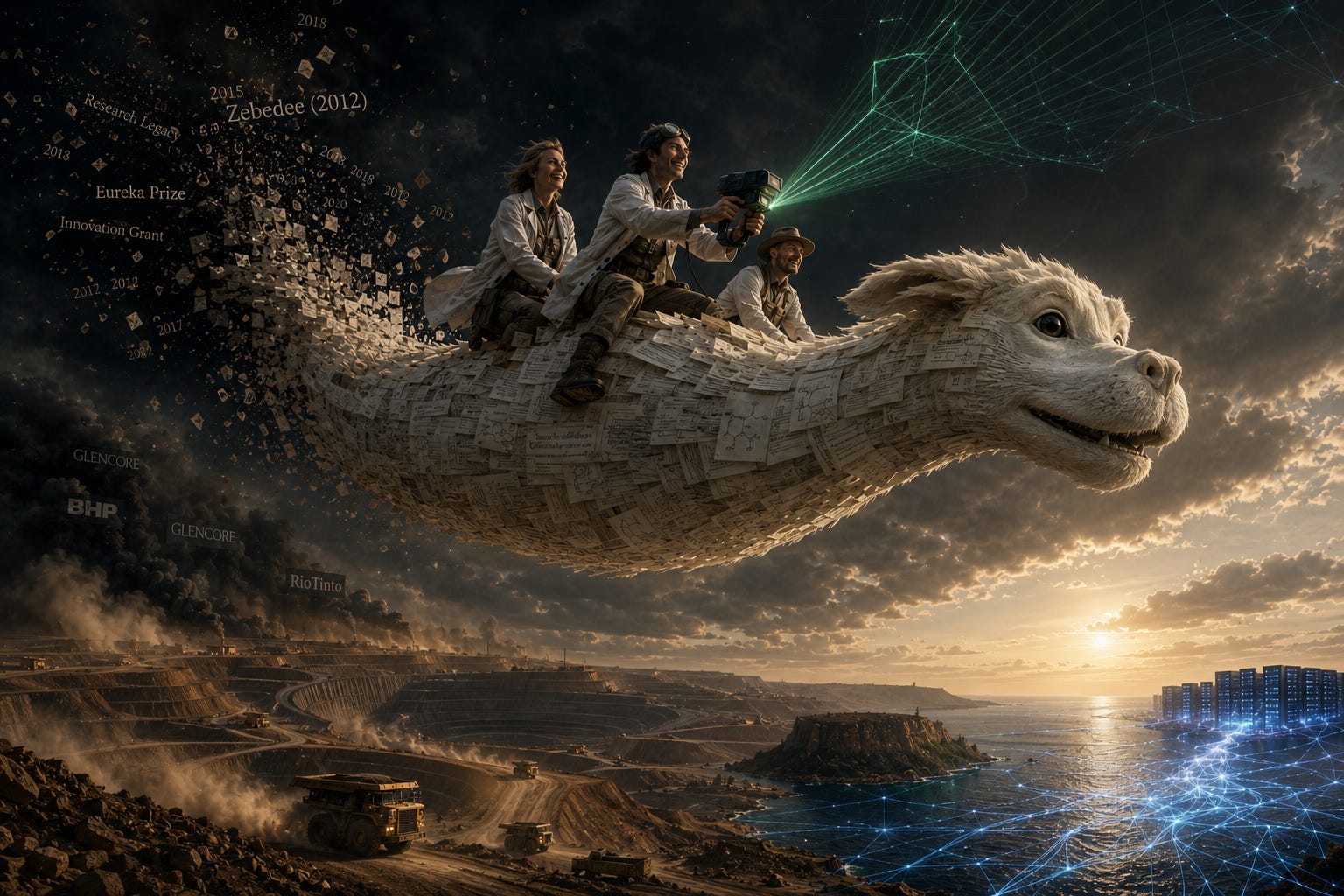
A note on how this postscript came to exist, because it turned out to prove the article’s own point. I had the image in mind — innovation as a never-ending story, scientists riding Falkor the luckdragon. That much was mine. But when I followed the thread with an AI, it revealed something I had not consciously remembered: that The Neverending Story is not really about endlessness at all. It is about the Nothing.
In Michael Ende’s tale, there is a world called Fantastica, made entirely of human imagination: everything ever dreamed, invented, or believed. It is being devoured by a force called the Nothing. The Nothing does not attack. It erases — quietly, without trace — so that pieces of the world simply cease to have existed, leaving only a vague emptiness where something used to be. And it spreads for one reason: because people in the real world have stopped believing in Fantastica, stopped visiting it, stopped telling its stories. Forgetting is the weapon. Neglect is the Nothing.
The machine told me that. And it could only tell me because Ende’s story had been written down, published, and preserved — sitting in the corpus, ready to surface at the moment it was needed. Which is precisely the thing this article argues Australia fails to do for its own knowledge. The AI revealed my own metaphor to me because someone, somewhere, kept the record. That is the entire argument, demonstrated in a single conversation.
The world is saved by two acts, and only two. Something must be named — an unnamed thing fades, a named thing endures. And the story must be carried forward by someone willing to keep telling it, because it has no last page. It is finished only when no one is left to continue it.
The parallel is exact. Australia’s innovation record is a small Fantastica, and the Nothing is already in it. Not as villainy — as neglect. Pages deleted in a restructure. Awards that fall off a website. An invention named once, on a page that lasted a month. A research line, still alive, recorded as a closed chapter from 2013. None of it was destroyed. It was simply not named, not tended, not carried forward — and so, piece by piece, it stops having existed.
The cure in the book is the cure here. Name the work and the people who did it. Then keep telling the story, because it does not end. That is what iwiki.au is: one reader who picked up the pen because the alternative was the Nothing. It should not fall to one reader. But the story only continues if someone writes the next page.